Login / Register


News & Reviews
Everything You Need to Know About Qatar's New Traffic Law 2026: Fines and Violations
18 Nov 2026
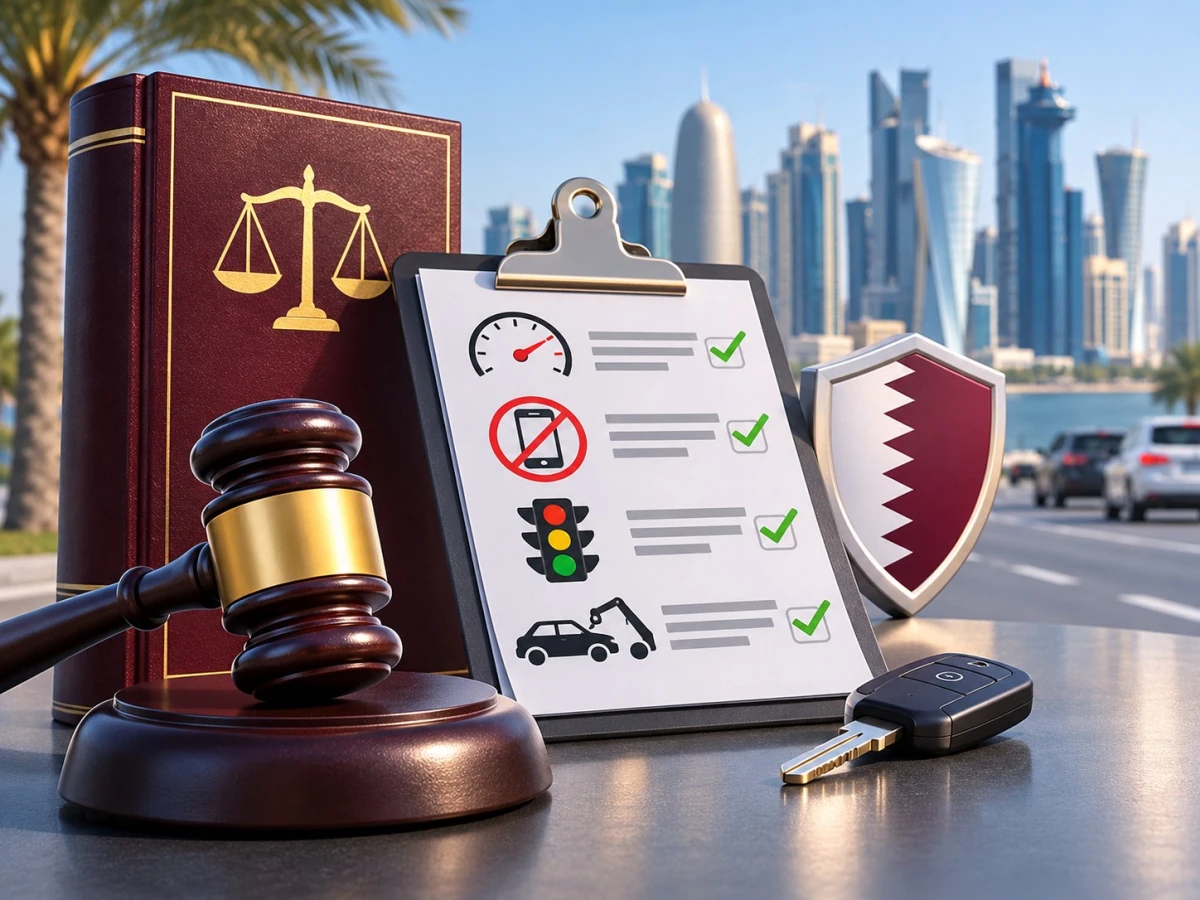
Traffic fines of up to QAR 100,000, imprisonment of up to three years, and 11 violations that could result in vehicle confiscation. Here is everything drivers need to know about Qatar's new Traffic Law.
Qatar's Official Newpaper, Issue No. 22 of 2026, has published the details of Law No. 19 of 2026 issuing the country's new Traffic Law. The legislation introduces a range of regulations and penalties aimed at improving road safety, reducing dangerous driving behaviour, and regulating vehicle use and related commercial activities.
The law includes stricter penalties for reckless driving, running red lights, using mobile phones while driving in specified circumstances, speeding, and driving without a valid licence.
It also introduces provisions governing vehicles leaving Qatar, commercial vehicle operations, truck loads, and activities related to vehicle sales, rentals, and maintenance.
In this comprehensive guide, we explain the most important provisions of Qatar's new Traffic Law and what they mean for drivers and vehicle owners.
1. Eleven Traffic Violations That Could Lead to Vehicle Confiscation
Article 117 is one of the most significant provisions of the new Traffic Law. It gives courts the authority to order the confiscation of a motor vehicle following a conviction for any of 11 specified offences.
Which violations could result in vehicle confiscation?
- Reckless or dangerous driving: Driving a vehicle carelessly or in a manner that endangers people's lives.
- Driving under the influence: Operating a vehicle while under the influence of alcohol, drugs, or other mind-altering substances.
- Using a mobile phone while driving: Holding and using a mobile phone or another electronic device by hand while driving, in cases of repeat offences.
- Driving a vehicle with a withdrawn registration or operating permit: Operating a vehicle whose permit has been withdrawn by a judicial or administrative decision.
- Driving with a suspended or withdrawn driving licence: Operating a vehicle after the driver's licence has been withdrawn by a court or administrative authority.
- Fleeing an accident or police order: Leaving or attempting to leave the scene of a traffic accident, or failing to stop when instructed by a police officer.
- Running a red light: Disobeying red traffic signals or traffic directions given by police officers.
- Excessive speeding: Exceeding the posted speed limit by more than 60 km/h.
- Driving against traffic: Driving in the wrong direction on highways or ring roads.
- Participating in unauthorised races: Taking part in road races without written permission or in violation of the conditions of an issued permit.
- Dangerous acceleration or drifting: Suddenly accelerating or swerving in a way that causes tyres to spin and produce excessive noise, without causing road damage, in cases of repeat offences.
Is vehicle confiscation automatic?
No. Article 117 states that a court may order vehicle confiscation after convicting the offender.
This means confiscation is not automatic in every case. It remains subject to the court's decision, while protecting the rights of third parties acting in good faith.
For mobile phone use and drifting-related offences, the confiscation provision specifically applies in cases of repeat violations.
2. Traffic Fines of Up to QAR 100,000 for Vehicles Leaving Qatar
Article 112 introduces one of the highest financial penalties under the new Traffic Law.
The punishment may include:
- Imprisonment for up to one year.
- A fine of up to QAR 100,000.
- Or either of these penalties.
This penalty applies to violations of Article 28, Paragraph 2, which requires vehicle owners to return their number plates within 30 days after the expiry of the authorised period for keeping their vehicle outside Qatar, unless the permit is renewed within that period.
The court must also order the return of the number plates.
Do you need permission to take your car outside Qatar?
Under Article 28, motor vehicles may not leave Qatar without authorisation from the licensing authority, except for goods transport vehicles and other categories exempted by a ministerial decision, subject to the applicable regulations.
The law also provides for a QAR 4,000 settlement amount for violations of the first paragraph of Article 28 concerning vehicles leaving Qatar without the required authorisation.
It is important to distinguish between leaving Qatar without the required permit and failing to return number plates after an authorised period expires, as the applicable penalties differ.
3. Speeding and Driving Too Slowly: Fines of Up to QAR 10,000
Qatar's new Traffic Law addresses not only speeding but also driving excessively slowly without a reasonable justification when doing so obstructs traffic.
Article 60 establishes several obligations concerning vehicle speed and road safety.
Important speed-related driving rules
- Do not exceed the maximum speed limit or drive below the minimum speed limit where applicable.
- Reduce speed near schools, hospitals, places of worship, shopping areas, parks, and pedestrian crossings.
- Slow down when approaching bends, intersections, roundabouts, bridges, and tunnels.
- Maintain control of the vehicle and adjust speed according to road conditions, weather, and vehicle load.
- Avoid driving unnecessarily slowly when it obstructs other vehicles.
- Do not brake suddenly unless necessary for road safety.
- Give clear and timely warning when preparing to reduce speed.
Under Article 111, violating Article 60 may result in imprisonment for up to one year, a fine of up to QAR 10,000, or either penalty.
How much is the settlement for speeding violations?
According to the published provisions, the settlement amount for speeding violations starts at QAR 500.
It increases by QAR 100 for every additional 10 km/h of excess speed, up to a maximum settlement amount of QAR 1,000.
Drivers should distinguish between the settlement amount and the maximum penalty that may be imposed by a court.
4. Serious Traffic Violations: Up to Three Years in Prison and QAR 50,000 in Fines
Article 109 covers a wide range of serious traffic offences.
The maximum punishment for these offences may reach three years of imprisonment and a fine of QAR 50,000, or either penalty, subject to the specific provisions of the law.
4.1 Driving without a valid licence
Drivers must hold a valid driving licence issued by the licensing authority that permits them to operate the relevant category of vehicle.
For repeat violations of the first paragraph of Article 35, Article 109 provides for mandatory imprisonment of up to three years, together with a fine of up to QAR 50,000.
4.2 Allowing an unlicensed person to drive
Vehicle owners and persons in possession of vehicles are prohibited from allowing someone without an appropriate driving licence to operate their vehicle.
4.3 Vehicle number plate violations
Registered motor vehicles must display two official number plates, one at the front and one at the rear.
Trailers and semi-trailers are required to display one plate at the rear.
4.4 Driving in the wrong direction
Driving against the designated direction of traffic is prohibited due to the serious risks it poses to other road users.
4.5 Violations on highways
The law prohibits drivers on highways from:
- Stopping outside designated areas.
- Reversing their vehicles.
- Making prohibited left turns or U-turns.
- Driving on the central reservation separating traffic directions.
4.6 Organising races without permission
Vehicle races, bicycle races, electric scooter races, and races involving pedestrians may not be organised on public roads without written authorisation from the licensing authority.
4.7 Driving under the influence of alcohol or drugs
Driving under the influence of alcohol, drugs, or other substances affecting mental awareness is classified as a serious traffic offence.
4.8 Fleeing an accident scene
Drivers are prohibited from fleeing or attempting to flee after a traffic accident or when instructed to stop by a police officer.
4.9 Disobeying traffic signals
Drivers must comply with traffic lights and directions issued by police officers.
When a police officer is manually directing traffic, the officer's instructions take precedence over other traffic signals.
4.10 Noisy or polluting vehicles
Vehicles that produce excessive noise, thick smoke, unpleasant odours, or substances harmful to public health or the environment, in violation of approved Qatari standards, are prohibited from operating on public roads.
All vehicles must also be equipped with a functioning exhaust silencer.
4.11 Acts contrary to public morals and traditions
Article 59 prohibits drivers from committing, or allowing others to commit, acts inside a vehicle that violate public morals or traditions.
4.12 Damaging traffic signs and road infrastructure
The law prohibits installing signs or devices that resemble official traffic signs or reduce their visibility.
It also prohibits damaging, moving, altering, or interfering with traffic signs, roads, bridges, and tunnels.
In specified cases, convicted offenders may also be required to pay compensation for damage based on the relevant authority's assessment.
4.13 Violating vehicle impoundment orders
Vehicle owners may not violate administrative vehicle impoundment orders.
Removing, damaging, relocating, or interfering with equipment used to immobilise vehicles is also prohibited.
The import, manufacture, sale, installation, and maintenance of vehicle immobilisation devices require approval from the licensing authority.
5. New Regulations for Car Dealerships, Rental Companies and Garages
The new Traffic Law also introduces important provisions affecting businesses operating in Qatar's automotive sector.
Under Article 48, the following activities require approval from the licensing authority:
- Buying and selling vehicles.
- Vehicle rental services.
- Vehicle inspection, repair, and decoration.
- Businesses dealing with electric scooters and similar vehicles.
- Operating vehicle parking facilities.
Article 49 also prohibits establishing or operating driving schools or providing driving instruction without the required licence.
Violations of these provisions fall within Article 109 and may carry penalties of up to three years in prison, a fine of up to QAR 50,000, or either penalty.
6. New Rules for Trucks, Vehicle Dimensions and Cargo Loads
Qatar's new Traffic Law establishes requirements for commercial vehicles, including maximum vehicle dimensions, axle loads, and cargo weight limits.
These regulations are designed to protect roads, bridges, and other infrastructure while improving safety for all road users.
Maximum vehicle dimensions and weight limits
| Category | Maximum Permitted Limit |
|---|---|
| Maximum vehicle height including cargo | 4.2 metres |
| Maximum vehicle width including cargo | 2.6 metres |
| Maximum load on a single axle | 13 tonnes, subject to manufacturer specifications |
| Maximum gross vehicle or vehicle combination weight | 45 tonnes, subject to other applicable restrictions |
| Maximum cargo extension beyond the front | 1 metre |
| Maximum cargo extension beyond the rear | 2 metres |
Special written authorisation is required where vehicle dimensions or cargo loads exceed the permitted limits under the applicable provisions.
Cargo must be securely arranged and fastened to prevent movement or falling.
Loads must not obstruct the driver's visibility, vehicle lights, direction indicators, or number plates.
Modifications to truck cargo compartments for the purpose of increasing their dimensions beyond the approved specifications are prohibited.
7. Special Traffic Rules for Trucks, Buses and Heavy Equipment
Under Article 50, drivers of trucks, buses, tractors, and vehicles towing trailers must keep to the right-hand side of the road and must not overtake other vehicles, as specified in the law.
The law also restricts the operation of machinery and heavy equipment on public roads, except for equipment specifically designed for road use.
Construction, excavation, demolition, and maintenance work that could obstruct traffic or endanger road users require the appropriate authorisation.
Contractors must install warning signs, follow the licensing authority's instructions, remove debris, and restore the affected area after completing the work.
8. What Is the Difference Between a Fine, Settlement and Vehicle Confiscation?
Drivers should understand that Qatar's Traffic Law distinguishes between three different legal measures.
Traffic fine
A financial penalty that may be imposed by a court within the limits established by law.
Settlement payment
A specified amount that may be paid to settle certain traffic offences in accordance with the applicable legal procedures.
Not all traffic violations are necessarily eligible for settlement.
Vehicle confiscation
A judicial measure that a court may order following a conviction for offences specified in the law.
Vehicle confiscation is different from temporary administrative impoundment.
Important: A maximum fine of QAR 50,000 or QAR 100,000 does not mean every driver committing the relevant offence will automatically be required to pay that amount.
9. Summary of Major Fines and Penalties Under Qatar's New Traffic Law
| Traffic Violation | Maximum Penalty |
|---|---|
| Failure to return vehicle number plates after the authorised period abroad expires | Up to one year in prison and QAR 100,000 |
| Serious traffic offences covered by Article 109 | Up to three years in prison and QAR 50,000 |
| Speed-related violations under Article 60 | Up to one year in prison and QAR 10,000 |
| Speeding violation settlement | From QAR 500 up to QAR 1,000 |
| Settlement for taking a vehicle outside Qatar without the required permit | QAR 4,000 |
| Eleven offences listed under Article 117 | Possible court-ordered vehicle confiscation |
Note: Where the law provides for both imprisonment and a fine, courts may impose either penalty in the specified cases, except where particular provisions expressly require otherwise.
10. What Does Qatar's New Traffic Law Mean for Drivers?
The new legislation sends a clear message that certain traffic offences may have consequences extending beyond financial penalties.
Depending on the offence, its circumstances, and the court's decision, violations may result in imprisonment or vehicle confiscation.
Drivers should pay particular attention to the following:
- Avoid holding and using mobile phones while driving.
- Observe posted speed limits.
- Never run red lights.
- Avoid reckless driving and drifting.
- Ensure driving licences and vehicle registrations remain valid.
- Follow the required procedures when taking vehicles outside Qatar.
- Comply with applicable vehicle load and dimension restrictions.
Vehicle owners, car dealerships, rental companies, and transport operators should also review the licensing, permit, and operational requirements relevant to their activities.
Conclusion: Everything Drivers Should Know About Qatar's New Traffic Law
Qatar's Traffic Law No. 19 of 2026 establishes a stricter legal framework for dealing with dangerous traffic violations while expanding the rules governing vehicles and automotive-related commercial activities.
The most important points are that fines may reach QAR 100,000, imprisonment may extend to three years, and 11 specified offences could lead to court-ordered vehicle confiscation.
The primary objective of the legislation is to encourage compliance with traffic regulations, protect lives and property, and improve road safety throughout Qatar.
Source: State of Qatar Official Gazette, Issue No. 22 of 2026, Law No. 19 of 2026 issuing the Traffic Law.
Recent Articles
Most Viewed
Advice


Related Articles